Along with eye colour we inherit fears, beliefs and repeating fates. How to recognise ancestral karma and let it go.
From our parents and grandparents we inherit not only eye colour or traits of character. We also inherit fears, beliefs, patterns of behaviour, and sometimes even similar fates. This is what I call ancestral karma: unfinished lessons that travel from generation to generation.
How to recognise it
Look at your family as one long story. Do similar things keep repeating? The women in the family end up alone or live with men who drink. The men cannot find their place and lose their businesses. Several generations struggle with poverty even though they work hard. The same illnesses repeat, the same divorces, the same age at which something happens. When you see a pattern repeating across three generations, it is worth stopping to think.
Where it comes from
Lithuanian families have lived through a great deal: wars, deportations, occupations, hunger, lost land. Experiences like these leave deep marks. Pain that was never cried out, fear that was never spoken, guilt that was kept silent are all passed on. Not in words, but through feelings and behaviour. A grandchild can fear the same thing a grandfather feared without even knowing why.
Does this mean fate is sealed
No. Ancestral karma is not a sentence. It is like an unread letter that keeps arriving until someone opens it and understands it. Often it is precisely one member of the family who becomes the one to complete the lesson. Then it becomes easier not only for them, but for their children too.
What you can do yourself
Take an interest in your family history. Talk to the older generation while you still can. Write down what happened to whom and what their fates were. Notice which sentences keep repeating in the family: “the men in our family never stay”, “there will never be money”. Ask yourself whether you truly believe this, or have only inherited it. And honour your ancestors: visit their graves, light a candle, remember them with a kind word. Gratitude releases a great deal.
If illnesses run in your family, be sure to tell your doctor. Bioenergy healing complements a medical examination, but it does not replace it.
How it affects children
Parents often ask whether their children will inherit the same lessons. From my experience I can say that when one member of the family consciously completes a lesson, things often become easier for the children. A mother who lets go of her fear about money no longer passes it on to her daughter through everyday words and worry. A father who understands where his anger comes from can treat his son differently. Children learn not from what we say, but from how we live. So working with ancestral karma is not only about the past. It is also about the future, about what you will leave to those who come after you. It is one of the most meaningful things you can do for your family. And there is no need to wait until the children grow up. You can start at any time.
What is ancestral karma, in simple words?
Ancestral karma is the set of unfinished lessons that a family passes down: fears, beliefs, patterns of behaviour and sometimes similar fates. It is not a punishment from above and not a fixed destiny. Think of it as a family habit of feeling and reacting that started with real events, such as war, loss or poverty, and kept repeating because nobody had the chance to process it.
Quieter signs of ancestral karma
Beyond repeating fates, there are quieter signs that often go unnoticed because they seem to be "just how our family is":
- There are topics nobody ever talks about: a death, a departure, a child who did not survive.
- One relative's name is avoided, as if they were erased from the family story.
- You feel a strong duty to rescue the family, even at the cost of your own life.
- Several generations emigrate or move, never putting down roots.
- Certain family dates bring an unexplained heaviness.
- One feeling dominates the family: constant worry, anger or shame, with no clear reason.
How to build a family tree with stories: 6 steps
- Draw three or four generations: you, your parents, grandparents, great grandparents and their siblings.
- Next to each person, write what you know: work, marriages, children, when and how they died.
- Mark the big events: war, deportation, lost land, early deaths, emigration.
- Ask older relatives what they remember, and note both their words and the feelings in their voice.
- Look for repetitions: the same age, the same illnesses, similar marriages, similar choices.
- Beside each repetition, write a question: what was this person afraid of, and what could they never say or finish?
Take your time. Some things surface only after several conversations, or from old documents and letters.
Ancestral karma and personal karma
Personal karma is about your own lessons, linked to your own choices and experiences. Ancestral karma comes through the family: what the whole line carries, a part of which lands on you. The two often intertwine, so in a diagnostic I look at both. Read more in what karma is, and about deeper layers in my article on past lives.
How to honour your ancestors in everyday life
Respect for your family line does not require big rituals. Small, sincere things are often enough:
- keep a photo of your grandparents where you will see it;
- tell your children about their ancestors, the hard parts as well as the good ones;
- preserve a family recipe, song or tradition;
- on anniversaries or on All Souls' Day, light a candle and remember them by name.
What matters is not the form but sincerity. When you remember your family with gratitude rather than fear, your relationship with its story changes.
How I work
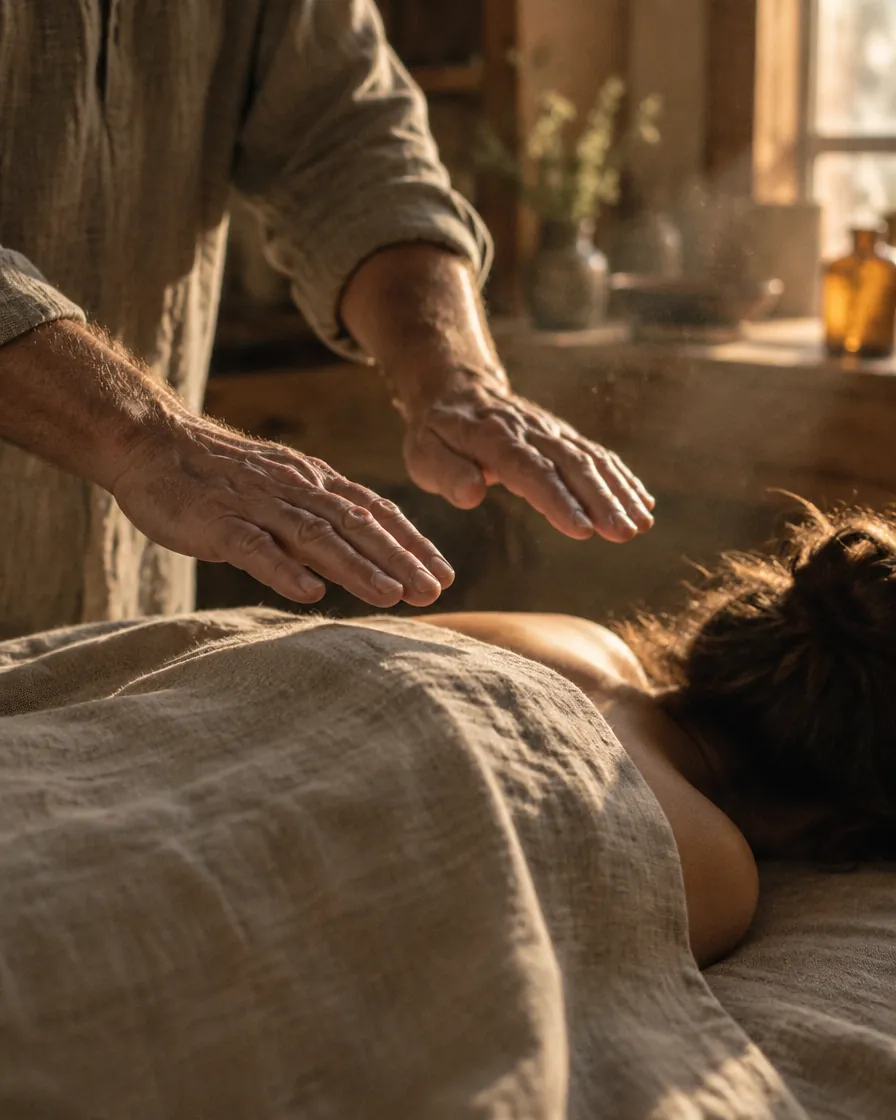
During karma diagnostics I see which family lessons are relevant to you now and where they come from. I explain what they mean, and what can be released, I release. Afterwards people often feel for the first time that they are living their own life, not repeating someone else’s.
If you want to understand your family story more deeply, give me a call. A consultation costs 200 €, in person or remotely. I carry out karma diagnostics at my studio in Kaišiadorys or remotely from a photo.
Frequently asked questions
Ancestral karma means unfinished lessons that travel through the generations of a family. From our ancestors we inherit not only looks but also fears, beliefs, patterns of behaviour and sometimes similar fates. They are passed on through feelings and behaviour rather than words. In my experience, it is not a sentence: when someone understands and completes the lesson, it often eases for others too.
Look at three or four generations. If similar fates, illnesses, divorces, poverty or losses at the same age keep repeating, it may be ancestral karma. Quieter signs include topics nobody talks about, relatives who were erased from the story and a feeling that dominates the family without a clear reason. I see it more precisely in a karma diagnostic.
In my experience, you can work with it: understand which lesson is active for you now and consciously complete it. What can be released, I release during the diagnostic. I do not promise that every difficulty will vanish in one session, though. After the first consultation I tell you honestly whether continuing makes sense.
No. A curse is an ill wish that someone once spoke. Ancestral karma grows out of what the family itself lived through: war, deportation, loss, unspoken pain. In my experience, what people call a family curse is most often exactly this karma. It does not call for a ritual, it calls for understanding what repeats and why.
Not always. Many illnesses are hereditary in the medical sense, so be sure to tell your doctor about them so they can be checked in time. Bioenergy work complements medical care but never replaces it. The karmic side can be looked at alongside medicine, never instead of it.
Karma is the sum of past actions, and its consequences affect us today. I find out which lessons you brought with you and what keeps repeating, so you can let it go and move on.
Learn more →