

Types of dowsing rods, how to hold them and walk a room, the most common mistakes, and what to do if a zone runs under your bed.
A dowsing rod is a simple tool: most often two metal wires bent into an L shape, or a forked twig shaped like a Y. People have used it for hundreds of years. In the old days, before building a house, villagers would call someone with a rod to show where to dig a well and where better not to build. Today dowsing rods are mostly used to find geopathic zones at home and at work. I have worked with a dowsing rod since 2010, so here I will explain plainly what kinds there are, how to use one and where people most often go wrong.
What a geopathic zone is
It is a place where, according to old folk and dowsing experience, a person's energy drains away over time. Such zones are usually linked to underground water veins or faults in the earth's crust. Walking through one briefly is nothing to fear, but sleeping or working in it every day is another matter. I want to be honest: science does not confirm the effect of geopathic zones. I am describing what I have seen in my own work over many years.
Types of dowsing rods
L-shaped rods. Two metal wires, the short end held in the hand and the long end pointing forward. This is the most common type and the easiest for a beginner. Sometimes the short end sits in a hollow handle so the wire can turn freely.
Y-shaped rod. A flexible forked twig, usually hazel or willow, held by its two ends with both hands. When it reacts, the tip suddenly dips down or rises up. This is the oldest form, the one our grandparents talked about.
Pendulum. A small weight on a thread or chain. It is more often used over a floor plan or a specific spot than for walking through rooms.
How to use dowsing rods
If you want to try it yourself with L-shaped rods, here is a simple routine:
1. Hold them loosely. Grip the wires lightly, as if holding two pencils. Elbows by your sides, forearms parallel to the floor, the tips pointing straight ahead.
2. Settle down. Stand still for a few moments before you start. When you rush or think about other things, your hands move on their own and the rods "show" anything.
3. Walk slowly. Step across the room slowly in a straight line. When the wires cross or swing apart, stop.
4. Mark the spot. Put a sticker or an object on the floor. Then walk over the same place from another direction. If the reaction repeats in the same spot, write it down.
5. Draw a plan. Transfer the marked spots onto a floor plan of the room. It then becomes easier to see where a line runs and whether it crosses a bed, a cot or a desk.
The most common mistakes
Beginners usually rush, grip the wires too tightly or walk on a slope, where the wires swing from their own weight. Draughts get in the way too. The biggest trap is expectation: if you already "know" the zone is under the bed, your hands will "show" it. Science explains the movement of dowsing rods precisely by small unconscious hand movements. That is why it is worth checking the same place several times and from different sides.
How I check a home
I walk through the rooms with a dowsing rod and watch where it reacts. This gives a kind of map: where the zones are, where they cross and where it is safe. I mark the spots on the floor plan. I check beds, children's rooms and workplaces especially carefully, because that is where people spend most of their time. After the check you know not only where the zones are, but also what to do about them next.
What to do if a zone runs under the bed
The simplest solution is to move the bed. Often shifting it a few dozen centimetres is enough. I give specific advice based on the layout of your home.
How to make dowsing rods at home
You do not need to buy anything to try. The simplest pair of L-shaped rods can be made from two metal coat hangers or a thicker wire:
- Cut two equal pieces of wire, about 50 cm long.
- Bend each one at a right angle so the short part is about 12 cm and the long part about 38 cm.
- Slide the short part into a hollow tube, such as an old pen body or a thick straw, so the wire turns easily without your grip holding it.
- Bend the tip of the long part into a small loop so you do not scratch yourself or the furniture.
- Check that both rods are the same length and straight. Crooked wires swing from their own weight.
How to test yourself honestly
Because hands follow expectations so easily, it is worth testing yourself in a way where you do not know the answer in advance:
- Ask someone else to mark a spot on a floor plan without showing it to you.
- Walk the room in several directions and note every reaction separately.
- Repeat it on another day, rested and calm, and compare your notes.
- If the reactions land in a different place each time, that is normal for a beginner, and a sign not to move furniture based on the results yet.
A dowsing rod does not diagnose illness or answer questions about the future. In my work it only helps find places better avoided for long stays. For what zones look like in a home, see the signs of geopathic zones.
Is it worth checking yourself
You can try, and it is an interesting experience. But a dowsing rod takes experience and calm, and first attempts are often unreliable. If you have doubts, or if you have felt uneasy at home for a long time, it is better to invite someone who has done this for years. For a check with a dowsing rod I come to your home, but sometimes a floor plan and a few photos are enough for me to tell you first whether a check is worth it.
Frequently asked questions
Hold two L-shaped rods loosely, elbows at your sides and forearms parallel to the floor, tips pointing forward. Stand still for a moment, then walk slowly in a straight line. When the rods cross or swing apart, stop and mark the spot. Walk over it again from another direction and only note reactions that repeat.
Science explains the movement of dowsing rods by small unconscious hand movements, and I say that openly. I have worked with a dowsing rod since 2010 and describe what I have seen in practice: many people sleep better after moving their bed. I treat it as experience, not as a scientifically proven fact.
In dowsing tradition the rods cross or swing apart above a spot they react to, such as a water vein or a zone line. But they also cross when you walk on a slope, when there is a draught or when your hands are tense. That is why every reaction is worth checking several times from different sides.
The easiest choice is two metal coat hangers or wire about 50 cm long, bent at a right angle. Putting the short end in a hollow tube lets the wire turn easily. For a Y-shaped rod people traditionally used a flexible hazel or willow twig. Expensive shop-bought rods are not more accurate than homemade ones.
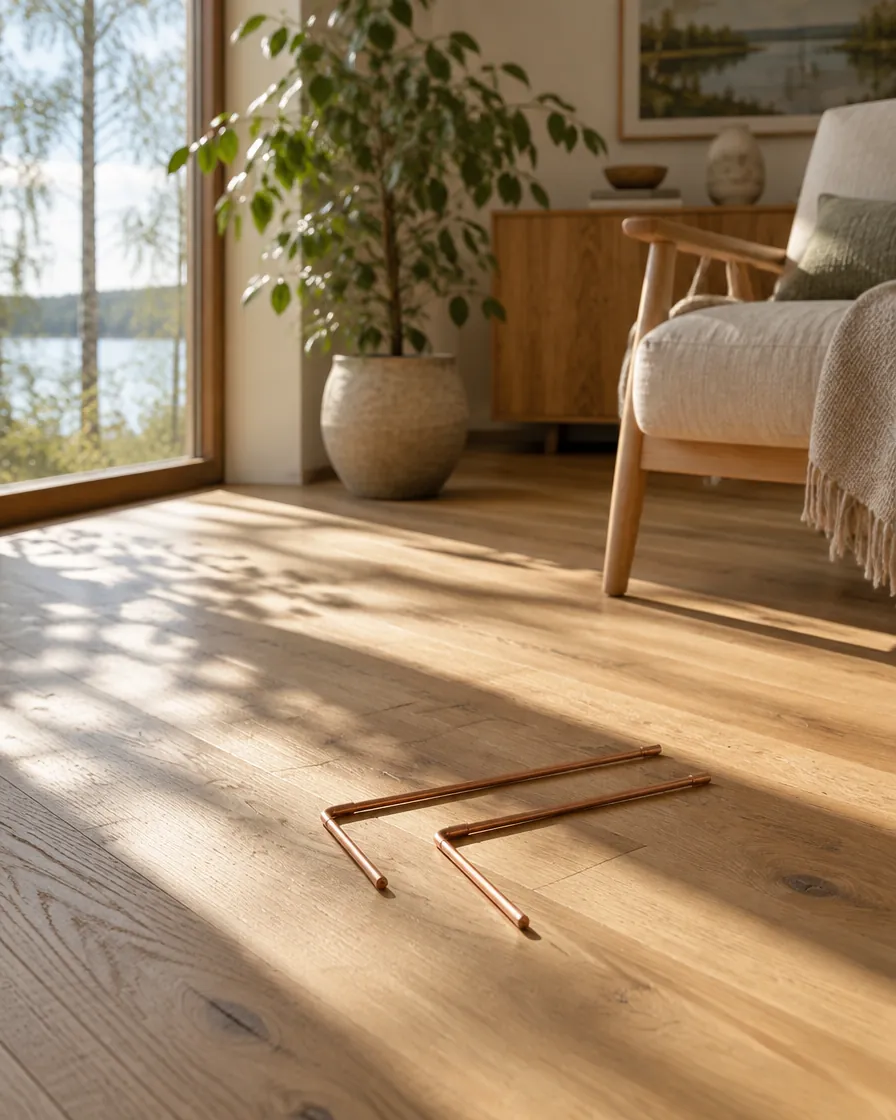
With a dowsing rod I find geopathic zones at home or at work and clear the space of heavy energy. Especially worth it if poor sleep started after a move, or children are restless in a room.
Learn more →